
News


News from our business partners

This is a guest blog by REC business partner, EBS.
Over the last year, we’ve been speaking to a lot of organisations about one thing: their DBS processes, especially since updates were made to the DBS ID checking guidance, introducing additional layers of verification.
Employers and recruiters must now complete an ID verification and Right to Work check before submission, as well as confirm how identities were verified when not using a digital identity verification service provider.
We’ve done the polling, and interestingly, the answer is rarely the DBS check itself slowing recruiters down.
Many organisations, particularly those operating in compliance-driven, high-volume environments, are finding that the manual processes around DBS submission are where delays (and associated risks) begin to build.
And it’s not just something we’re hearing directly.
Through our Recruitment & Employment Confederation, Eteach Group, and Better Hiring Institute partnerships as well as wider industry conversations, we’re seeing the same challenges echoed across recruitment teams navigating these changes in real time.
Before and during submission of DBS applications, the traditional manual process usually looks something like this:
The impact is real. Sometimes it’s immediate, other times it builds over time and compounds. You start to see it in:
Reducing this manual processing has been a big focus for us over the last year.
Our MD, Matt Masson, has been working closely with industry bodies through the Association of RecTech Providers (ARTP), alongside service providers and regulatory stakeholders, to help shape how the industry responds to hiring challenges.
This is about improving the background screening part of the recruitment process and addressing a wider issue across the UK’s hiring system. One consistent theme the keeps emerging is that traditional manual background screening processes are no longer sustainable at scale.
We’ve worked closely with our customers to understand how we can simplify identity verification, Right to Work, and DBS submission into one process.
Then built (Enhanced, Standard, and Basic) DBS HI-ID to remove the friction around DBS processing, for recruiters, employers, and candidates.
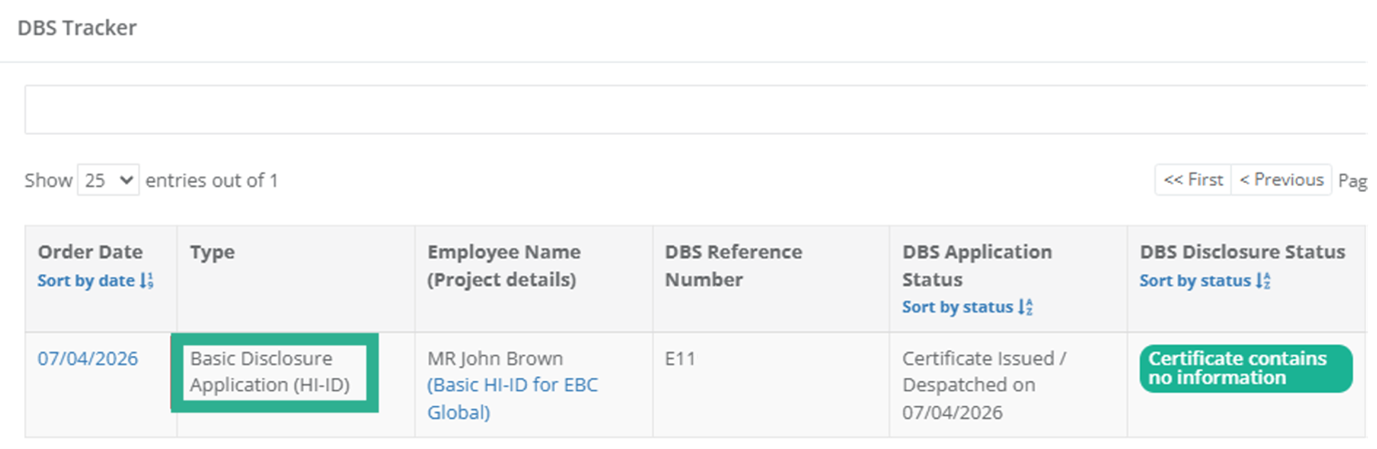
Recently, we ran a Basic DBS HI-ID check with a client.
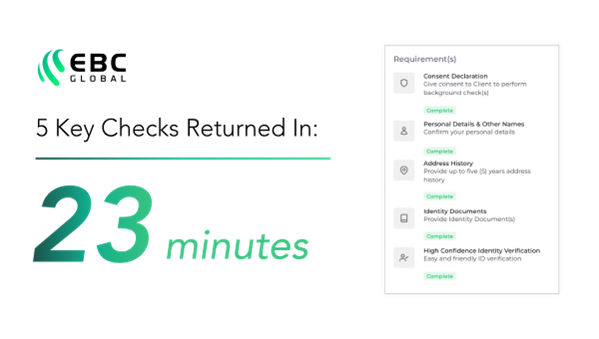
Once the candidate completed their actions, this was the outcome:
All checks started at the same time, with a total completion time of 23 minutes.
By partnering and integrating directly with Responsible Organisations (RO), DBS Umbrella Bodies (RB), and Digital Verification Service providers (DVS, formerly IDSP), you remove unnecessary manual and third-party intervention, reducing average processing times.
We re-engineered the traditional countersigning model with predefined, role-based workflows (for example: teacher-specific journeys), reducing average processing times from 23 days under traditional RO/RB vetting to around 10 days with EBC Global.
By removing the delays, and manual intervention before submission, so there are:
Even when an additional check was needed, it was added into the same journey without slowing things down.
For teams managing DBS checks day to day, introducing automation can change a lot:
And that is exactly why we built DBS HI-ID. A way to bring identity verification, Right to Work, address verification, and DBS submission into a single, automated process.
Not just to make things faster, but to make them more accurate, more compliant, and easier to manage at scale.
We recently hosted a short 30-minute practical session where we explored:
We’re supporting organisations in handling the updated DBS identity checking requirements more efficiently, sharing what’s working in practice across recruitment and compliance teams.
If you’re reviewing your DBS process this year or just want a practical run-through of what safer recruitment screening looks like in reality, it should be a useful watch.
Reduce DBS Submission Errors By Simplifying The ID Checking Process
Feel free to share this with your team as well.
Alternatively, you can start a free 12-day screening trial or book a demo to see how organisations are combining identity verification, Right to Work, address verification, and DBS submission into one automated journey across Enhanced, Standard, and Basic DBS applications.
Share this article